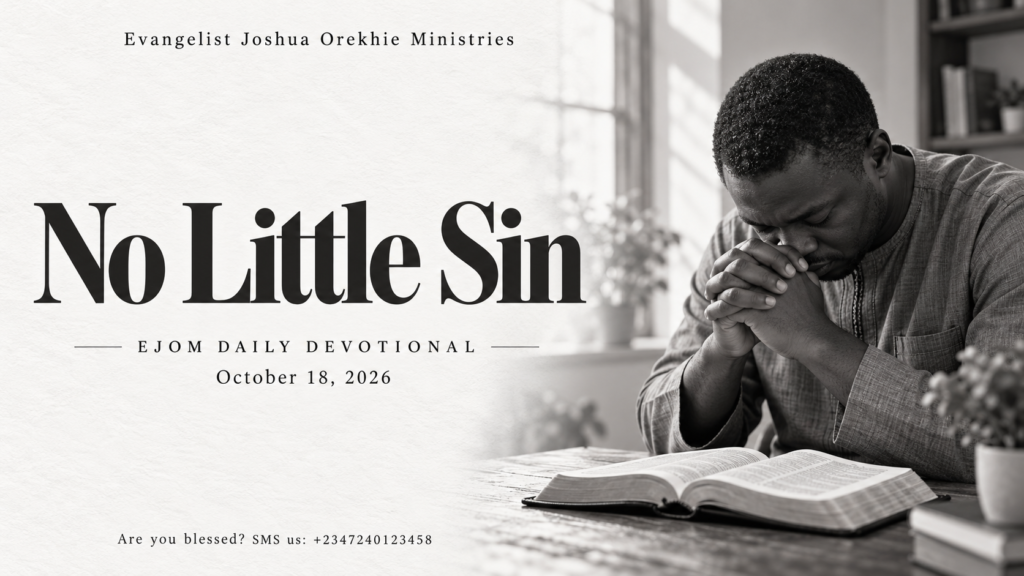
Evangelist Joshua Orekhie Ministries
EJOM DAILY DEVOTIONAL:
October 18, 2026
NO LITTLE SIN
OPENING SCRIPTURES
James 2:10 (KJV): “For whosoever shall keep the whole law, and yet offend in one point, he is guilty of all.”
1 Corinthians 5:6 (KJV): “Your glorying is not good. Know ye not that a little leaven leaveneth the whole lump?”
Romans 6:23 (KJV): “For the wages of sin is death; but the gift of God is eternal life through Jesus Christ our Lord.”
MEMORY VERSE
1 John 1:9 (KJV): “If we confess our sins, he is faithful and just to forgive us our sins, and to cleanse us from all unrighteousness.”
Song of Solomon 2:15 (KJV): “Take us the foxes, the little foxes, that spoil the vines: for our vines have tender grapes.”
PRAISE AND WORSHIP
Sing any of your favourite songs.
No Little Sin – EJOM DAILY DEVOTIONAL: October 18, 2026
Beloved, one of the most dangerous mistakes many Christians make today is categorising certain sins as little, harmless or insignificant.
Some people believe that as long as they are not committing what society considers serious offences, their relationship with God is perfectly fine.
They go to church, they pay their tithes, they sing in the choir, they lift their hands in worship, and yet they quietly carry “small” sins in their pockets as though God does not see them.
Look closely at the double standard of our generation. Many condemn murder but excuse hatred. They condemn adultery but entertain lustful thoughts. They condemn the politician who steals billions but justify taking small amounts dishonestly from their own workplace.
We condemn murder, armed robbery and adultery, while we excuse lying, gossip, envy, pride and dishonesty as “normal human weakness.” But Scripture does not allow us to treat sin lightly. God does not grade sin the way men do.
James 2:10 says, “For whosoever shall keep the whole law, and yet offend in one point, he is guilty of all.” You do not need to break every link of a chain to fall; break one link, and the whole chain gives way.
Sin is any thought, word, action or attitude that goes against the character, command and will of God. It may be something wrong that you have done, or something right that you knowingly refused to do.
James 4:17 says, “Therefore to him that knoweth to do good, and doeth it not, to him it is sin.” Sin is not only what we commit; it is also what we omit.
Consider a simple example. Someone trusts you with a private matter. You tell yourself, “It is harmless to mention it to just one person,” and before long you are broadcasting it to others.
“A talebearer revealeth secrets: but he that is of a faithful spirit concealeth the matter” (Proverbs 11:13). Another example is a person who takes a small amount that does not belong to him and says, “Nobody will notice it.”
If the heart is not corrected, that person gradually becomes comfortable with that type of sin. What began as a little thing slowly becomes a lifestyle.
Proverbs 6:16–19 lists seven things that are an abomination to the Lord: “A proud look, a lying tongue, and hands that shed innocent blood, An heart that deviseth wicked imaginations, feet that be swift in running to mischief, A false witness that speaketh lies, and he that soweth discord among brethren.”
Look carefully at that list. The proud look stands beside the bloody hands. The lying tongue stands beside the murderer. The one who sows discord in the church stands on the same list as the one who sheds innocent blood.
These are sins many people commit every day without a second thought, yet God calls them an abomination. Then Jesus raised the standard even higher.
In the Sermon on the Mount, He went beyond the act to the heart. He taught that anger without cause is a seed of murder (Matthew 5:22).
He said, “whosoever looketh on a woman to lust after her hath committed adultery with her already in his heart” (Matthew 5:28). And He warned, “every idle word that men shall speak, they shall give account thereof in the day of judgment” (Matthew 12:36).
Beloved, God is not only interested in what your hands have done; He is interested in what your heart is entertaining. The issue is not the size of the sin but the holiness of the God against whom it is committed.
Isaiah 59:2 declares, “your iniquities have separated between you and your God, and your sins have hid his face from you, that he will not hear.”
It does not take a mountain to block the sun from your eyes. A small coin, held close enough to your eye, can hide the whole sun. In the same way, a “small” sin held close to the heart can block the face of God from your life.
Your prayers become heavy, your worship becomes empty, your discernment becomes dull, and you begin to wonder why heaven seems silent.
Every sin, whether men call it big or small, offends the same holy God, and every sin was paid for by the same precious blood. The nails that pierced the hands of Jesus were not only for murderers and armed robbers; they were also for liars, gossips, the proud and the envious.
If it took the blood of the Son of God to pay for it, then it is not little. People have many ways of making sin look small:
“It is just a small lie.” But the Bible says, “Lying lips are abomination to the LORD” (Proverbs 12:22). Satan is called the father of lies (John 8:44). Every lie, however small, carries his signature of destruction.
“Everybody does it.” But God told Israel, “Thou shalt not follow a multitude to do evil” (Exodus 23:2). The crowd will not stand before God on your behalf on the day of judgment.
“Nobody is perfect.” That is true, but it is not an excuse to remain in sin. God’s command still stands: “Be ye holy; for I am holy” (1 Peter 1:16). Our imperfection is a reason to run to grace, not a licence to stay in sin.
“God understands my weakness.” Yes, God understands, but understanding is not approval. He understands your weakness so that He can give you strength, not so that you can continue in it. Paul asked, “Shall we continue in sin, that grace may abound? God forbid” (Romans 6:1–2).
A small sin is like a small hole in a boat. It may not sink you today. You may even keep sailing for a long time and think all is well. But if that hole is ignored, water keeps entering quietly, until one day the whole vessel goes down.
The devil is clever. He rarely asks a child of God to commit a great wickedness on the first day. If he came to you and said, “Destroy your marriage,” you would rebuke him.
If he said, “Become a drunkard,” you would cast him out. If he said, “Go and slap the man,” you would laugh at him. So he does not begin there. He begins with something small, something that looks harmless, something everybody else seems to be doing.
He says, “It is just a friendship.” That is how he introduces a married man to a single lady, or a married woman to another woman’s husband. “We are only chatting.” “We only go out for lunch.”
“Nothing will happen between us.” Then come the late night calls, the secret messages, the emotional attachment, and before long, a home is broken, children are scattered, and a destiny is in ruins. Proverbs 6:27 asks, “Can a man take fire in his bosom, and his clothes not be burned?”
He says, “It is just in private. Nobody will see you” That is how he introduces secret pornography and self-gratification. “It is not hurting anybody.” “At least I am not committing fornication.” But what is fed in private grows in power.
The secret habit becomes a chain, lust becomes an appetite that is never satisfied, the mind becomes polluted, and many are drawn into deeper bondage, sexual immorality and spiritual defilement. Every lust that is fed will demand more.
He says, “It is just a little drink to relax yourself.” That is how many have been introduced to alcohol and other substances. “One glass will not hurt.” “It is just for the occasion.” But one glass becomes two, two becomes a bottle, and the bottle becomes a master.
Proverbs 20:1 warns, “Wine is a mocker, strong drink is raging: and whosoever is deceived thereby is not wise.” Many who said “just a little” are today slaves to what they once thought they could control.
He says, “It is just a small amount.” That is how many begin to steal from their employers, church finances, inflate receipts, divert funds and collect bribes. The first time, the hand trembles. The second time, the conscience whispers.
By the tenth time, the heart is hardened and the amount has grown.
Beloved, this is the strategy of hell. James 1:14–15 explains it: “every man is tempted, when he is drawn away of his own lust, and enticed. Then when lust hath conceived, it bringeth forth sin: and sin, when it is finished, bringeth forth death.”
Desire, then sin, then death. Sin never stays small. It grows until it is finished, and when it is finished, it brings forth death.
Many destinies have been destroyed by what others called a little sin. The little sin has tarnished many reputations.
Men and women who were respected in their communities, honoured in their churches and celebrated in their professions have been disgraced because of a “small” secret that was eventually exposed.
Ecclesiastes 10:1 says, “Dead flies cause the ointment of the apothecary to send forth a stinking savour: so doth a little folly him that is in reputation for wisdom and honour.” Years of good name can be destroyed by one dead fly.
The little sin has locked many people in jail. Many who are behind bars today did not plan to end up there. It began with a small fraud, a small cheating, a small bad company, a small “favour” for a friend. Numbers 32:23 warns, “be sure your sin will find you out.”
The little sin has caused many to lose their purpose. Esau sold his birthright for one plate of food (Hebrews 12:16). Samson lost his strength, his eyes and his freedom through a series of small compromises on Delilah’s lap (Judges 16).
Gehazi, who could have inherited a double portion anointing like Elisha, collected a few gifts and told a small lie, and walked away with leprosy instead of anointing (2 Kings 5:27).
Moses struck a rock instead of speaking to it, and the great deliverer could only look at the Promised Land from the mountain (Numbers 20:12; Deuteronomy 34:4).
Beloved, behind many broken marriages, failed ministries, ruined careers, lost destinies and early graves, there is a little sin that was ignored.
There is also a spiritual dimension that we must not ignore. Ephesians 4:27 commands, “Neither give place to the devil.” Every sin we tolerate gives the enemy a place, a foothold, a legal ground to stand in our lives.
This is why some people pray for deliverance and the problem keeps returning. They bind the spirit of poverty while keeping small dishonesty. They rebuke attacks in their marriage while keeping secret flirtations.
They cast out lust while still feeding it in private. The enemy that is cast out through the front door returns through the back door that sin has left open. Ecclesiastes 10:8 says, “whoso breaketh an hedge, a serpent shall bite him.”
But when you close the doors of sin, the enemy loses his ground. Jesus said, “the prince of this world cometh, and hath nothing in me” (John 14:30). May the enemy come to your life and find nothing in you.
Beloved, this message is not to condemn you but to set you free. The devil has two lies concerning sin. Before you sin, he says, “It is too small; it does not matter.” After you sin, he says, “It is too big; God will never forgive you.” Both are lies from the pit of hell.
Here is the truth: sin is serious, but the blood of Jesus is greater. “If we confess our sins, he is faithful and just to forgive us our sins, and to cleanse us from all unrighteousness” (1 John 1:9).
“There is therefore now no condemnation to them which are in Christ Jesus” (Romans 8:1). And “sin shall not have dominion over you: for ye are not under the law, but under grace” (Romans 6:14).
So stop calling sin small. Call it what God calls it. Confess it, forsake it, and where you have wronged others, make it right. Break off the friendship that is leading you astray. Delete what is defiling you.
Pour away what is enslaving you. Return what is not yours. Walk away from the company that is pulling you down. And ask the Holy Spirit to give you the strength to live holy.
Solomon said, “Take us the foxes, the little foxes, that spoil the vines: for our vines have tender grapes” (Song of Solomon 2:15). Your life is a vineyard. Your marriage, your children, your ministry, your career and your destiny are tender grapes. Do not allow little foxes to eat your harvest.
Beloved, there is no sin too small to take seriously. Grace is not permission to continue in sin. Grace is the power of God that enables us to reject sin and live in a way that honours Him.
Paul asked, “Shall we continue in sin, that grace may abound? God forbid” (Romans 6:1–2). The grace that forgives you is the same grace that is available to transform you. Never use God’s mercy as an excuse to protect what Christ died to deliver you from.
Beloved, guard your thoughts. Many destructive actions begin as thoughts that are repeatedly entertained. You may not control every thought that enters your mind, but you can decide whether you will nurture it, believe it and act upon it.
As the old saying goes, you cannot stop birds from flying over your head, but you can stop them from building a nest in your hair. Paul instructs us to be “bringing into captivity every thought to the obedience of Christ” (2 Corinthians 10:5).
David’s sin with Bathsheba did not end with lust. It began with a decision to stay home when kings went to battle, continued with a look from the rooftop, and developed into adultery, deception and the arranged death of Uriah (2 Samuel 11).
One sinful decision opened the door to several others. Sin will often take you farther than you intended to go, keep you longer than you intended to stay, and cost you more than you expected to pay.
Never call the misuse of your mouth a little sin. “Death and life are in the power of the tongue” (Proverbs 18:21). A careless joke can humiliate someone. An angry statement can remain in another person’s heart for years.
A false accusation can destroy what took decades to build. James warns that the tongue is a little member, yet it can set a whole forest on fire (James 3:5–6). Jesus said that “every idle word that men shall speak, they shall give account thereof in the day of judgment” (Matthew 12:36).
So, beloved, repent before a wrong desire becomes a destructive action. Deal with anger before it turns into violence.
Correct that mistakes before it destroys your credibility. Confront lust before it ruins your marriage or your purity. Stop the little fox before it spoils the vineyard (Song of Solomon 2:15).
Some people compare their sins with the sins of others. They say, “At least I have not killed anyone,” “I am better than that person,” or “My own is not serious.” But another person’s disobedience cannot make yours acceptable before God.
The Pharisee in the temple thanked God that he was not like other men, but it was the tax collector who beat his breast and cried, “God be merciful to me a sinner,” who went home justified (Luke 18:11–14).
James 2:10 says, “For whosoever shall keep the whole law, and yet offend in one point, he is guilty of all.” Every sin reveals our failure to meet God’s perfect standard and shows our need for His mercy. The question is not how your sin compares with another person’s sin, but how it stands before a holy God.
The proper response to sin is neither self-righteousness nor despair. It is repentance and faith in Jesus Christ. “If we confess our sins, he is faithful and just to forgive us our sins, and to cleanse us from all unrighteousness” (1 John 1:9).
Confession means agreeing with God about what you have done, calling it what He calls it, without excuses or softer names. Repentance means turning away from it. Repentance is more than feeling sorry because you were caught or because consequences followed.
“For godly sorrow worketh repentance to salvation… but the sorrow of the world worketh death” (2 Corinthians 7:10). Genuine repentance produces a sincere desire for change.
Zacchaeus demonstrated true repentance by correcting the wrong he had done. He stood before the Lord and said, “if I have taken any thing from any man by false accusation, I restore him fourfold” (Luke 19:8).
In the same way, repentance may sometimes require an apology, returning what belongs to another person, ending an immoral relationship, or establishing accountability. True repentance does not only weep; it also acts.
Beloved, secret sin is still sin. The absence of witnesses does not mean the absence of God. “The eyes of the LORD are in every place, beholding the evil and the good” (Proverbs 15:3).
Joseph understood this. When Potiphar’s wife tempted him day after day, and there was no one else in the house, he asked, “how then can I do this great wickedness, and sin against God?” (Genesis 39:9).
Joseph’s concern was not merely whether people would discover him. He understood that his private choice mattered before God. Integrity is what you practise when there is no audience, no applause and no immediate possibility of exposure.
Never admire your own public spirituality while ignoring private compromise or mistake. You may preach powerfully, pray well and serve actively, but yet still protect a secret habit that is gradually affecting your fellowship with God.
Samson kept winning public battles while his private life was decaying, until the day “he wist not that the LORD was departed from him” (Judges 16:20). What is hidden in private will eventually affect what happens in public.
God exposes sin to restore us, not merely to condemn us. When the Holy Spirit convicts you, respond quickly. Do not silence your conscience with repeated excuses or it doesn’t matter.
The longer you tolerate sin, the more normal it begins to feel in your spirit. What once troubled you will no longer move you once the conscience signal alarm system is dead.
Hebrews 3:13 warns against being “hardened through the deceitfulness of sin.” Sin has deceived a lot of people. It tells you that you can stop whenever you choose, that nobody will be affected, and that consequences will never arrive.
But that’s a lie from the pit of hell. Every sin has a seed, and every seed has a harvest. Ask the Holy Spirit to search your heart. David prayed,
“Search me, O God, and know my heart: try me, and know my thoughts: And see if there be any wicked way in me, and lead me in the way everlasting” (Psalm 139:23–24). This is the prayer of someone who desires cleansing more than the appearance of perfection.
The devil has two lies concerning sin. Before you sin, he says, “It is too small; it does not matter.” After you sin, he says, “It is too big; God will never forgive you.” Both are lies from the pit of hell.
Never allow shame to keep you away from God. The enemy may tell you that you have gone too far, but the blood of Jesus is powerful enough to cleanse all who genuinely repent.
“There is therefore now no condemnation to them which are in Christ Jesus” (Romans 8:1). Come boldly to the throne of grace and receive mercy (Hebrews 4:16).
At the same time, mercy must never be treated carelessly. Forgiveness was purchased through the sacrifice of Jesus Christ. Sin is serious because it separates, corrupts and destroys our image and authority.
Grace is precious because Christ paid the price we could never pay. The cross shows us both how terrible sin is and how great God’s love is. Stay close to God’s Word: “Thy word have I hid in mine heart, that I might not sin against thee” (Psalm 119:11).
Avoid environments that continually strengthen temptation: “make not provision for the flesh, to fulfil the lusts thereof” (Romans 13:14). Joseph did not stay to negotiate with temptation; he ran and left his garment behind (Genesis 39:12).
Sometimes deliverance from temptation requires practical changes: changing your routine, ending certain relationships, deleting certain applications, avoiding certain places, or limiting your access to what weakens you. Prayer and discipline must work together.
And if you fall, rise again through repentance. Do not settle into sin because you failed once. “For a just man falleth seven times, and riseth up again” (Proverbs 24:16).
God can restore you, strengthen you and teach you to walk in victory, for “sin shall not have dominion over you: for ye are not under the law, but under grace” (Romans 6:14).
Final Word
Beloved, there may be sins people call little, but there are no sins worth keeping. The pleasure is temporary, while the consequences can reach far beyond the moment, into your marriage, your children, your reputation, your purpose and your eternity.
Today, surrender every hidden compromise to Christ. Bring it into the light. Lay it at the foot of the cross. And pray with David, “Create in me a clean heart, O God; and renew a right spirit within me” (Psalm 51:10).
There is no little sin, but there is a great Saviour who is ready to save you but not condemn you. Run to Him today, and He will cleanse you, deliver you and teach you to walk in victory.
WISDOM FOR TODAY
The sin you excuse today will accuse you tomorrow. Kill the fox while it is a cub, for if you feed it, it will one day eat your harvest.
PERSONAL CHALLENGE
Today, ask the Holy Spirit to show you three “little foxes” in your life. Write them down. Confess each one to God, and where you have wronged someone, take a practical step to make it right: return what is not yours, apologise, settle a debt, or tell the truth. Remove one thing from your phone, home or routine that makes sin easier for you.
EVANGELISM CHALLENGE
Many people think they are good enough for heaven because they have not committed “big” sins. Share with at least one person today that “all have sinned, and come short of the glory of God” (Romans 3:23), but that Jesus Christ died to forgive every sin and give eternal life to all who believe in Him (Romans 6:23).
FURTHER STUDY
📖 Genesis 3:1–19; Genesis 4:6–8; Genesis 13:10–13; Genesis 19:1, 26; Numbers 20:7–12; Numbers 32:23; Joshua 7:1–26; Judges 16:4–21; 2 Samuel 11:1–27; 2 Kings 5:20–27; Psalm 19:12–14; Psalm 51:1–12; Psalm 119:9–11; Proverbs 4:23; Proverbs 6:16–19; Proverbs 28:13; Ecclesiastes 10:1, 8; Song of Solomon 2:15; Isaiah 59:1–2; Matthew 5:21–30; Matthew 12:36–37; Luke 16:10; Luke 17:32; Luke 19:1–10; John 14:30; Acts 5:1–11; Romans 5:12; Romans 6:1–23; Romans 8:1–4; 1 Corinthians 5:6–8; Galatians 5:9; Ephesians 4:25–32; 1 Thessalonians 5:22; Hebrews 3:12–13; Hebrews 12:1, 14–17; James 1:12–15; James 2:10; 1 John 1:7–2:2
PRAYER ASSIGNMENT – MORNING
1. Father, I thank You because You are holy, and Your eyes are too pure to behold evil, in Jesus’ name.
2. Thank You, Lord, for the blood of Jesus that cleanses from all sin.
3. Father, forgive me for every sin I have called small in my life, in Jesus’ name.
4. Lord, forgive me for every lie, exaggeration and false excuse I have told others, in Jesus’ name.
5. Father, forgive me for every act of dishonesty in my work, business and finances, in Jesus’ name.
6. Lord, forgive me for every careless word, gossip and backbiting from my mouth, in Jesus’ name.
7. Father, forgive me for every lustful look and impure thought I have entertained, in Jesus’ name.
8. Lord, forgive me for envy, bitterness, pride and unforgiveness in my heart, in Jesus’ name.
9. Lord, deliver me from the double standard of condemning others while excusing myself, in Jesus’ name.
10. Father, cleanse my heart from hatred, lust, envy and pride, in Jesus’ name.
11. Every “small lie” in my mouth, be replaced with the truth of God, in Jesus’ name.
12. I reject the excuse “everybody does it”; I choose to follow God and not the crowd, in Jesus’ name.
13. Every ungodly friendship disguised as innocent, Lord, expose it and separate me from it, in Jesus’ name.
14. Every spirit of adultery and strange relationships targeting my marriage, be destroyed, in Jesus’ name.
15. Every secret habit of lust and self-gratification, lose your hold on my life, in Jesus’ name.
16. Every image of impurity stored in my mind, be washed away by the blood of Jesus, in Jesus’ name.
17. Every bondage to alcohol or any substance that began with “just a little,” break now, in Jesus’ name.
18. Every small dishonesty in my work and finances, Lord, forgive me and give me grace to make restitution, in Jesus’ name.
19. Every dead fly in the ointment of my reputation, be removed, in Jesus’ name.
20. Every little sin that is pushing my life toward shame or prison, be uprooted, in Jesus’ name.
21. Lord, let me not lose my purpose to any little fox, in Jesus’ name.
22. Every door I have opened to the enemy through sin, be shut by the blood of Jesus, in Jesus’ name.
23. Every legal ground of the enemy in my life, be cancelled by the blood of the Lamb, in Jesus’ name.
24. Every spirit of condemnation telling me God cannot forgive me, be cast out, in Jesus’ name.
25. Father, give me the grace to confess, forsake and walk away from every sin, in Jesus’ name.
26. I decree that sin shall not have dominion over me, for I am under grace, in Jesus’ name.
27. Blood of Jesus, wash me thoroughly from my iniquity and cleanse me from my sin, in Jesus’ name.
28. Holy Spirit, shine Your light on every little fox in my life, in Jesus’ name.
29. Every little fox spoiling my marriage, be caught and cast out, in Jesus’ name.
30. Every little fox spoiling my ministry, be exposed and removed, in Jesus’ name.
31. Every little fox spoiling my career and finances, be destroyed, in Jesus’ name.
32. Every little fox spoiling my walk with God, be uprooted, in Jesus’ name.
33. Every little leaven of sin spreading in my life, be purged by the fire of God, in Jesus’ name.
34. Every door I have opened to the enemy through sin, be shut by the blood of Jesus, in Jesus’ name.
35. Every legal ground the enemy is claiming in my life through sin, be cancelled by the blood of Jesus, in Jesus’ name.
36. Every accuser of the brethren gathering evidence against me, be silenced by the blood of the Lamb, in Jesus’ name.
37. Every demon that entered my life through compromise, I command you to leave now, in Jesus’ name.
38. Every foothold of the devil in my mind, emotions and body, be destroyed, in Jesus’ name.
39. Every hedge around my life broken by sin, be restored by the mercy of God, in Jesus’ name.
40. Every serpent waiting to bite through a broken hedge, be destroyed, in Jesus’ name.
41. Lord, let the prince of this world come and find nothing in me, in Jesus’ name.
42. Every habitual sin that keeps returning in my life, lose your power over me, in Jesus’ name.
43. Every chain of addiction that began with “just once,” break now, in Jesus’ name.
44. Every desire in me that is conceiving sin, be aborted by the power of God, in Jesus’ name.
45. Lord, help me to rule over sin before it rules over me, in Jesus’ name.
46. Father, keep me back from presumptuous sins; let them not have dominion over me, in Jesus’ name.
47. Lord, guard my heart with all diligence, in Jesus’ name.
48. Father, set a watch before my mouth and keep the door of my lips, in Jesus’ name.
49. Lord, I make a covenant with my eyes; sanctify my sight, in Jesus’ name.
50. Father, let Your Word be hidden in my heart, that I might not sin against You, in Jesus’ name.
51. Lord, give me the grace to abstain from all appearance of evil, in Jesus’ name.
52. Father, help me to lay aside every weight that makes sin easy for me, in Jesus’ name.
53. Lord, make me faithful in little things, so that You can trust me with much, in Jesus’ name.
54. Father, give me the courage to make restitution wherever I have wronged others, in Jesus’ name.
55. Lord, deliver me from the spirit of “everybody is doing it,” in Jesus’ name.
56. Thank You, Lord, because there is no little sin, but there is a great Saviour who has set me free, in Jesus’ mighty name. Amen.
PRAYER ASSIGNMENT – NIGHT
1. Father, thank You for keeping me from falling throughout this day, in Jesus’ name.
2. Lord, if I have sinned in thought, word or deed today, forgive me and cleanse me, in Jesus’ name.
3. Blood of Jesus, cover me, my family and my household tonight.
4. Every little fox that wants to enter my vineyard in the night, be caught at the gate, in Jesus’ name.
5. Every evil seed sown into my life in the dream, be uprooted, in Jesus’ name.
6. Every dream pollution designed to introduce sin into my life, be cancelled, in Jesus’ name.
7. Every spirit spouse attempting to defile me in the dream, be bound and cast out, in Jesus’ name.
8. Every satanic suggestion planted in my mind during sleep, be destroyed, in Jesus’ name.
9. Every power that wants to use my weakness against me, be disgraced, in Jesus’ name.
10. Every accusation of the enemy against me tonight, be silenced by the blood of Jesus, in Jesus’ name.
11. Every legal ground that the enemy is using to attack me at night, be cancelled, in Jesus’ name.
12. Every evil covenant I entered through ignorance or sin, be broken by the blood of Jesus, in Jesus’ name.
13. Every curse that came upon me through disobedience, be broken, in Jesus’ name.
14. Every consequence of past sins following my life, be stopped by the mercy of God, in Jesus’ name.
15. Every serpent that bit me through a broken hedge, release your poison and die, in Jesus’ name.
16. Lord, restore every hedge of protection around my life tonight, in Jesus’ name.
17. Every secret sin that wants to grow in the dark, be exposed and destroyed, in Jesus’ name.
18. Lord, deliver me from every habit that wants to grow into a stronghold, in Jesus’ name.
19. Father, purge my mind of every impure image and thought, in Jesus’ name.
20. Lord, deliver my children from the snares of little foxes, in Jesus’ name.
21. Father, protect my marriage from every little fox of compromise, in Jesus’ name.
22. Lord, let every member of my household walk in holiness, in Jesus’ name.
23. Holy Spirit, give me dreams of instruction and purity tonight, in Jesus’ name.
24. Every arrow of temptation fired at me tonight, fall to the ground and die, in Jesus’ name.
25. Lord, renew a right spirit within me as I sleep, in Jesus’ name.
26. Father, create in me a clean heart, in Jesus’ name.
27. Lord, let me wake up tomorrow with greater sensitivity to sin and greater love for holiness, in Jesus’ name.
28. Every condemnation and guilt that wants to steal my peace tonight, be removed, in Jesus’ name.
29. Father, let me never trade my birthright for a morsel of meat, in Jesus’ name.
30. Father, preserve me from every Gehazi spirit of greed and deception, in Jesus’ name.
31. Lord, connect me with godly people who will exhort and correct me, in Jesus’ name.
32. Father, keep my heart tender to the conviction of the Holy Spirit, in Jesus’ name.
33. Every spirit of condemnation trying to drive me away from You, be cast out, in Jesus’ name.
34. I receive grace to live in holiness and freedom from the power of sin, in Jesus’ name.
35. I decree that sin shall not have dominion over me, for I am under grace, in Jesus’ name.
36. Every little fox that wants to enter my vineyard in the night, be caught at the gate, in Jesus’ name.
37. Every satanic suggestion planted in my mind during sleep, be destroyed, in Jesus’ name.
38. Every accusation of the enemy against me tonight, be silenced by the blood of Jesus, in Jesus’ name.
39. Every evil covenant I entered through ignorance or sin, be broken by the blood of Jesus, in Jesus’ name.
40. Every curse that came upon me through disobedience, be broken, in Jesus’ name.
41. Every consequence of past sins pursuing my life, be stopped by the mercy of God, in Jesus’ name.
42. Every serpent that bit me through a broken hedge, release your poison and die, in Jesus’ name.
43. Every secret sin that wants to grow in the dark, be exposed and destroyed, in Jesus’ name.
44. Every habit that wants to grow into a stronghold, be uprooted, in Jesus’ name.
45. Father, purge my mind of every impure image and thought, in Jesus’ name.
46. Lord, heal every person I have wounded with my words, and give me grace to make peace, in Jesus’ name.
47. Father, deliver my children from the snares of little foxes, in Jesus’ name.
48. Lord, protect my marriage from every little fox of compromise, in Jesus’ name.
49. Father, let every member of my household walk in holiness, in Jesus’ name.
50. Every arrow of temptation fired at me tonight, fall to the ground and die, in Jesus’ name.
51. Holy Spirit, give me dreams of instruction and purity tonight, in Jesus’ name.
52. Every guilt and condemnation trying to steal my peace tonight, be removed by the blood of Jesus, in Jesus’ name.
53. I receive the peace of a forgiven child of God, in Jesus’ name.
54. No evil shall befall me and no plague shall come near my dwelling, in Jesus’ name.
55. I decree that the little foxes shall not spoil my vine; my life shall bear fruit unto holiness, in Jesus’ name.
56. Lord, forgive me for every good thing I knew to do today but did not do, in Jesus’ name.
57. Father, forgive me for every secret I revealed that was entrusted to me, in Jesus’ name.
58. Blood of Jesus, wash me clean from every stain of today, in Jesus’ name.
59. Lord, let me not go to sleep with any unconfessed sin in my heart, in Jesus’ name.
60. Father, help me not to let the sun go down on my anger; I release everyone who offended me today, in Jesus’ name.
61. Blood of Jesus, cover my bed, my room, my house and my household tonight.
62. Every little fox that wants to creep into my life in the night, be caught at the gate, in Jesus’ name.
63. Every spirit husband or spirit wife assigned to pollute my dream life, be bound and cast out, in Jesus’ name.
64. Every satanic feeding in the dream, be neutralised by the blood of Jesus, in Jesus’ name.
65. Every power that brings temptation to me in the dream, be disgraced, in Jesus’ name.
66. Every evil thought planted in my mind at night to lead me into sin tomorrow, be uprooted, in Jesus’ name.
67. Every habit that becomes stronger at night, lose your grip on me, in Jesus’ name.
68. Every secret sin that operates in the darkness of my life, be exposed by the light of God, in Jesus’ name.
69. Every chain of addiction that began with “just a little,” break tonight, in Jesus’ name.
70. Every evil covenant formed through past sins, be broken by the blood of Jesus, in Jesus’ name.
71. Every consequence of past sins following my family, be stopped by the mercy of God, in Jesus’ name.
72. Thank You, Lord, for Your grace that is greater than all my sin, in Jesus’ mighty name. Amen.
AFRICAN PROVERB
“If you do not fill a crack, you will build a wall.” (Swahili proverb)
Meaning: A small crack in a wall, if ignored, will widen until the whole wall must be rebuilt at great cost. In the same way, a “small” sin left unattended will grow until it brings great damage. It is wiser and cheaper to deal with a matter while it is small than to wait until it becomes a disaster.
CLOSING REFLECTION
Beloved, the enemy rarely destroys a destiny with one great blow. He prefers the quiet work of little foxes, dead flies and small leaven. But today, the light of God has shone on the vineyard of your life. You have seen the foxes. Now catch them.
Do not excuse what God calls sin. Do not wait until the crack becomes a collapse. Confess it, forsake it, close the door, and walk in the grace that empowers you to live holy.
Remember, the same grace that forgives you is the grace that trains you “that, denying ungodliness and worldly lusts, we should live soberly, righteously, and godly, in this present world” (Titus 2:12).
There is no little sin, but there is a great Saviour. Run to Him today, and let your vine bear fruit unto holiness. Shalom.
If you have any dreams, please don't hesitate to share it with me on my Youtube. I will be happy to proffer solutions to your dream requests.Evangelist Joshua TV