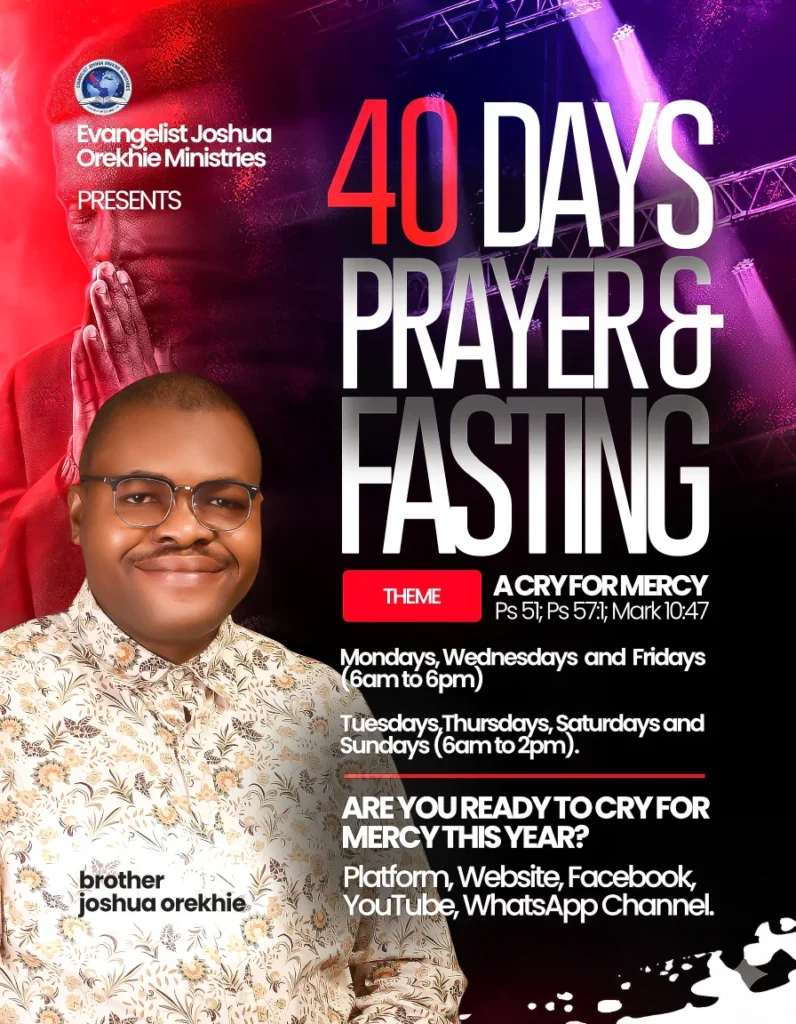
Evangelist Joshua Orekhie Ministries
EJOM DAILY DEVOTIONAL:
August 20, 2026
TOPIC: CRY OUT TO GOD NOW
OPENING SCRIPTURES
Psalm 34:17–19 (KJV)
“The righteous cry, and the LORD heareth, and delivereth them out of all their troubles. The LORD is nigh unto them that are of a broken heart; and saveth such as be of a contrite spirit. Many are the afflictions of the righteous: but the LORD delivereth him out of them all.”
Exodus 2:23-25 (KJV)
“And it came to pass in process of time, that the king of Egypt died: and the children of Israel sighed by reason of the bondage, and they cried, and their cry came up unto God by reason of the bondage. And God heard their groaning, and God remembered his covenant with Abraham, with Isaac, and with Jacob. And God looked upon the children of Israel, and God had respect unto them.”
Mark 10:46-48 (KJV)
“And they came to Jericho: and as he went out of Jericho with his disciples and a great number of people, blind Bartimaeus, the son of Timaeus, sat by the highway side begging. And when he heard that it was Jesus of Nazareth, he began to cry out, and say, Jesus, thou Son of David, have mercy on me. And many charged him that he should hold his peace: but he cried the more a great deal, Thou Son of David, have mercy on me.”
MEMORY VERSE (KJV)
Jeremiah 33:3, “Call unto me, and I will answer thee, and shew thee great and mighty things, which thou knowest not.”
Praise and Worship
Spend quality time worshipping God as the One who hears the cries of His children. Thank Him because He has not forgotten you. Thank Him for battles He has already fought, prayers He has answered, dangers He has prevented, and situations from which He has delivered you.
Worship Him because even when you cannot see what He is doing, He remains faithful. Tell Him sincerely, “Father, I have come before You today because You are my help, my refuge, my defender, and my hope.”
EJOM DAILY DEVOTIONAL: August 20, 2026 – Cry Out To God Now
Beloved, there comes a time when you must stop carrying everything silently and cry out to God. You have thought about the problem enough. You have worried about it enough. You have discussed it with people enough. You have cried secretly enough.
You have tried to appear strong before everybody, yet deep inside your heart you know there is a battle that requires divine intervention. Today, God is reminding you that you need to cry out to Him now.
Crying out to God does not necessarily mean shouting at the top of your voice. You can cry to God quietly. You can cry through your tears. You can cry through fasting and prayer. You can cry through a broken heart that says, “Lord, I cannot carry this alone anymore.
To cry out to God is more than shedding tears. It means calling upon Him with urgency, humility, faith and complete dependence.
Tears may accompany the prayer, but it is not the loudness of your voice or the quantity of your tears that moves God. What matters is the sincerity of your heart, your faith in His power and your willingness to surrender the matter to Him.
There is a difference between crying because you have lost hope and crying to God because your hope is in Him. The Bible contains many people who cried to God. David cried out to God.
Hannah poured out her soul before God. Israel cried out in Egypt. Jehoshaphat cried when surrounded by enemies. Blind Bartimaeus cried for mercy. The disciples cried when they thought they were going to perish.
Even Jesus, during His earthly suffering, offered prayers with strong crying and tears according to Hebrews 5:7. Therefore, crying before God is not necessarily a sign of spiritual weakness. Sometimes tears are the language of a heart that has reached the end of its own explanations.
Many people cry, but not everybody directs their cry toward God. Some cry and become bitter. Some cry and begin blaming everybody. Some cry and keep away from certain people.
Some cry and make destructive decisions. Some cry and seek revenge. Some cry and backslide. But David said in Psalm 18:6, “In my distress I called upon the LORD, and cried unto my God.” David knew where to direct his distress.
Beloved, where do you carry or direct your pain? Where do you carry your burdens to? Who receives your first call when trouble comes? There is nothing wrong with speaking to trustworthy people. But it’s important to direct your pain to God first before any person.
But wrong to discuss your problem with people and forget to talk sincerely to God. Some people can spend three hours explaining their situation to friends and five minutes praying about it.
They can post their frustration everywhere on social media, call people, send messages to people, and then say, “I don’t even know what to do.”
Beloved, have you prayed? Have you truly opened your heart before God? Have you said, “Father, this is where I am. This is what is happening. I need wisdom. I need strength. I need direction. Please help me”?
There are people reading this devotional who are tired about life. You have been fighting the same battle for a long time. You have prayed, waited, hoped, and believed, but the situation still remain the same.
Perhaps it concerns your marriage, finances, health, children, career, business, ministry, immigration matter, family, or another private burden that people around you do not fully understand.
You smile when people see you, but your heart is asking, “Lord, when will this situation change?” Some people carry heavy burdens silently because they believe God is too busy to listen to them. Others feel their problems are too small to bring before Him.
But the God who created the universe is also concerned about every detail of your life. 1 Peter 5:7 says: “Casting all your care upon him; for he careth for you.” If something troubles your heart, bring it to God. He cares about your family, health, marriage, children, finances, ministry, work and future.
Hannah understood what it meant to cry out to God. For years, she endured barrenness, provocation and emotional pain. Her rival continually mocked her, and even her husband could not fully understand her sorrow.
1 Samuel 1:10–11 says: “And she was in bitterness of soul, and prayed unto the LORD, and wept sore. And she vowed a vow, and said, O LORD of hosts, if thou wilt indeed look on the affliction of thine handmaid, and remember me, and not forget thine handmaid.”
Hannah did not fight Peninnah physically or exchange insults with her. She took her pain into the presence of God. Even when Eli misunderstood her, she remained focused on the One who could change her story.
Her cry became the beginning of her testimony, and the woman who entered the temple with sorrow eventually conceived and gave birth to Samuel.
Beloved, people may misunderstand your tears, but God understands them. Psalm 56:8 says: “Thou tellest my wanderings: put thou my tears into thy bottle: are they not in thy book?” No tear shed in faith is wasted before God.
He sees the nights you could not sleep, the disappointments you could not explain and the burdens you carried while pretending to be strong before people.
The children of Israel also cried out to God when they suffered under oppression in Egypt. Exodus 3:7–8 says: “And the LORD said, I have surely seen the affliction of my people which are in Egypt, and have heard their cry by reason of their taskmasters; for I know their sorrows; And I am come down to deliver them out of the hand of the Egyptians.” Their cry reached heaven, and God raised Moses as an instrument of deliverance.
This means your cry can provoke divine intervention. God can raise a helper, open a door, expose a secret, overturn an evil decision or create a way where none appears to exist.
You may not know how the answer will come, but God knows whom to send and what to do. The Israelites were surrounded by enemies and limited by slavery, yet one intervention from God changed the direction of an entire nation.
Blind Bartimaeus was another person who refused to remain silent. When he heard that Jesus was passing by, he cried out for mercy. Mark 10:47–48 says: “And when he heard that it was Jesus of Nazareth, he began to cry out, and say, Jesus, thou Son of David, have mercy on me. And many charged him that he should hold his peace: but he cried the more a great deal, Thou Son of David, have mercy on me.”
The crowd tried to silence Bartimaeus, but he understood that his opportunity for healing had come. He refused to allow public opinion, shame or intimidation to stop him. His persistent cry attracted the attention of Jesus, and the man who had been sitting helplessly by the roadside received his sight.
There are voices that may try to silence your prayer. The enemy may tell you that God will not answer you because you have prayed before without seeing results. People may call you too spiritual or even discourage you from trusting God.
But when you know the God you are calling upon, you will refuse to keep quiet. Cry out for mercy when you have made mistakes. Cry out for direction when you are confused.
Cry out for strength when you feel weak. Cry out for deliverance when you are oppressed. Cry out for restoration when something valuable has been lost.
Cry out for healing when you are ill. Cry out for wisdom and take the practical steps God reveals to you. Jonah cried to God from the belly of the fish.
Jonah 2:1–2 says: “Then Jonah prayed unto the LORD his God out of the fish’s belly, And said, I cried by reason of mine affliction unto the LORD, and he heard me; out of the belly of hell cried I, and thou heardest my voice.”
Jonah’s location did not prevent God from hearing him. He was in darkness, surrounded by water and trapped where no human being could reach him, yet his prayer reached heaven.
Your location cannot limit God. Whether you are in a hospital, prison, foreign country, troubled home, lonely room or difficult workplace, God can still hear you. Jonah had disobeyed God, but when he cried out sincerely, God gave him another opportunity.
However, crying out to God should not become an excuse for avoiding responsibility. After praying, obey every instruction He gives you. If you need to apologise, humble yourself. If financial discipline is required, correct your spending. If your health needs professional attention, visit qualified medical personnel.
Prayer and responsible action must work together. Sometimes God allows us to reach the end of our own ideas so that we can recognize how much we need His wisdom. Many people pray only after every personal strategy has failed. They try manipulation first.
They try connections. They try pressure. They try shortcuts. They try people. They try questionable methods. Then when everything fails, they remember God.
Beloved, God should not become your last option. Seek Him at the beginning. Proverbs 3:5–6 says, “Trust in the LORD with all thine heart; and lean not unto thine own understanding. In all thy ways acknowledge him, and he shall direct thy paths.”
Before signing the agreement, pray. Before accepting the proposal, pray. Before entering the relationship, pray. Before relocating, pray. Before investing, pray and investigate.
Before employing someone, pray and conduct appropriate checks. Before making major decisions, seek God and seek wisdom. Crying to God should not be reserved only for emergencies.
Beloved, sometimes the reason you need to cry out is because you have carried the burden silently for too long. You smile before people, but inside you are exhausted. Everybody believes you are strong because you are always encouraging others.
You answer everybody’s calls. You pray for everybody. You solve people’s problems. You carry family responsibilities. You appear confident publicly, but privately your heart is tired. Beloved, God did not command you to pretend before Him.
Psalm 62:8 says, “Trust in him at all times; ye people, pour out your heart before him: God is a refuge for us.” Notice the expression: pour out your heart.
God is not intimidated by your tears. He is not confused by your questions. He is not shocked because you admit you are tired. Bring your heart to Him. But also remember that sometimes exhaustion requires rest, support, boundaries, or appropriate counselling in addition to prayer.
Elijah in 1 Kings 19 was tired and discouraged, and God allowed him to sleep and eat before further instructing him. Sometimes your cry to God may be answered partly by God showing you that you need to rest.
Beloved, cry out when temptation is becoming stronger than your resistance. Refuse to wait until you fall before praying. Jesus told His disciples in Matthew 26:41, “Watch and pray, that ye enter not into temptation.” When you notice that old sinful desires are becoming attractive again, cry out.
When masturbation begins calling your attention again, pray and attack the cause. When anger is becoming uncontrollable, pray and step away before speaking destructively. When jealousy is entering your heart, pray.
When greed is beginning to influence your decisions, pray. When you feel yourself gradually becoming spiritually cold, cry out to God. Do not wait until a spark becomes a fire before looking for water.
Cry out to God when your prayer life is dying. There are seasons when you will struggle to pray. You will notice that yo no longer have the hunger to study the Bible, worship God and speak in tongues. You find excuses for everything spiritual.
Things that once convicted you no longer bother you. Beloved, do not normalize spiritual coldness. Cry out: “Lord, revive me again.” Psalm 85:6 says, “Wilt thou not revive us again: that thy people may rejoice in thee?”
Sometimes the breakthrough you need is not money, marriage, promotion, or a new opportunity. The breakthrough you desperately need is a revived heart.
Cry out when sin has trapped you. Do not hide because you are ashamed. David sinned seriously, but in Psalm 51 he cried for mercy. Psalm 51:10 says, “Create in me a clean heart, O God; and renew a right spirit within me.”
Beloved, if you have fallen, return to God. Confess honestly. Repent sincerely. 1 John 1:9 tells believers that if we confess our sins, God is faithful and just to forgive and cleanse us.
Cry out when you are confused about direction. Jeremiah 33:3 says, “Call unto me, and I will answer thee, and shew thee great and mighty things, which thou knowest not.” There are times when your greatest need is not immediate action but clarity. You have two opportunities and do not know which one to choose.
Cry out when your family is in trouble. Parents, pray for your children, but also communicate with them. Spouses, pray for your marriage, but also address problems honestly.
If there is abuse, violence, or danger, prayer should not be used to pressure someone to remain unsafe; seek appropriate protection and professional help.
If there is financial crisis, pray and review the finances. If there is persistent conflict, pray and consider wise counselling. Faith does not cancel responsibility.
Nehemiah 4:9 says, “Nevertheless we made our prayer unto our God, and set a watch against them day and night.” They prayed and they took practical precautions. That is biblical balance.
Cry out when you are sick, but also seek appropriate healthcare. James 5 teaches believers to pray, and Scripture never requires us to reject legitimate treatment. God can work through prayer, doctors, medication, surgery, counselling, nutrition, rest, and other appropriate means.
Do not turn a medical condition automatically into evidence of demonic activity. Pray earnestly, seek competent medical attention, follow responsible advice, and continue trusting God.
Cry out when your finances are collapsing, but after praying, examine your financial behaviour. Ask yourself difficult questions. Is the problem lack of income, uncontrolled spending, excessive debt, poor planning, fraud, an unsustainable business model, or responsibilities greater than your present capacity?
Pray for provision, but also ask God for wisdom. Sometimes the miracle you need includes a new opportunity. Sometimes it includes discipline. Sometimes it includes learning a new skill.
Sometimes it includes reducing expenses. Sometimes it includes asking for professional financial advice. Cry out to God, then remain willing to obey the wisdom He gives.
There are times when your cry should simply be, “Lord, have mercy.” Bartimaeus did not begin with a complicated prayer. He cried for mercy. The publican in Luke 18:13 said, “God be merciful to me a sinner.” Mercy recognizes that our confidence is not in our perfection.
Beloved, sometimes you have made mistakes. Sometimes the problem was not caused entirely by somebody else. Sometimes your own decisions contributed to what you are experiencing. In such moments, do not spend all your prayer time blaming enemies. Say, “Father, show me where I went wrong. Have mercy on me. Give me wisdom to correct what can be corrected.”
Look also at Peter in Matthew 14. He stepped out of the boat and walked on water toward Jesus. But when he saw the wind, he became afraid and began to sink. Peter did not have time for a long prayer meeting.
Matthew 14:30 says, “he cried, saying, Lord, save me.” Three words: Lord, save me. And verse 31 says, “And immediately Jesus stretched forth his hand, and caught him.”
Beloved, there are moments when prayer does not need impressive vocabulary. When you are sinking, cry. When temptation is pulling you, cry. When confusion overwhelms you, cry.
When your faith is failing, cry. “Lord, save me. Lord, help me. Lord, guide me. Lord, have mercy.” God understands sincere prayer.
But beloved, after crying out, listen. Many people speak continuously in prayer but never create room to reflect upon Scripture, examine their behaviour, receive wise counsel, or recognize necessary changes.
If you ask God for direction, be willing to follow direction that challenges your preference. If you cry, “Lord, deliver me from debt,” but refuse to change reckless spending, you are resisting part of the answer.
If you cry, “Lord, save my marriage,” but refuse to apologize, communicate, or seek help, you may be resisting necessary change.
If you cry, “Lord, give me a job,” but refuse to develop skills, prepare applications, or attend interviews, prayer is being separated from responsibility. James teaches that faith without works is dead. Cry out, then be ready to act wisely.
Beloved, do not wait until everything becomes unbearable before calling upon God. Cry out now. If you notice your marriage is drifting, pray now. If you notice change in your child’s behaviour, pray and communicate now. If you notice your spiritual life is going down, seek God now.
If you notice a destructive habit returning back, confront it now. If you notice financial warning signs, pray and address them now. If you are carrying unresolved bitterness, bring it before God now.
If you need to forgive, begin now. If you need to apologize, do it now. If you need appropriate medical attention, seek it now. If you need counsel, seek it now. If you need to return to God after wandering, return now.
There is power in the word “now.” Second Corinthians 6:2 says, “behold, now is the accepted time; behold, now is the day of salvation.” Some people always plan to become serious with God later.
“When I marry, I will serve God.” “When I become successful, I will pray more.” “When I overcome this habit, I will return to church.” “When things become easier, I will seek God.” Beloved, tomorrow is not guaranteed. Start now.
Cry out for your spiritual life now. Cry out for wisdom now. Cry out for mercy now. Cry out for strength now. Cry out for direction now. Cry out concerning that temptation now.
Cry out concerning that decision now. Cry out concerning your family now. Cry out concerning your future now., Cry out concerning the burden you have been carrying secretly now.
Also understand that God’s answer may not always look like the answer you requested. Paul prayed three times concerning his thorn in the flesh. Instead of removing it, God said, “My grace is sufficient for thee.” Sometimes God changes the situation.
Sometimes He changes us within the situation. Sometimes He gives us strength to endure while we continue seeking appropriate solutions. Sometimes He closes the door.
Sometimes He redirects us. Sometimes the answer is immediate; sometimes it unfolds gradually. Prayer is not done to control God. But prayer is bringing ourselves and our needs before a loving, wise, sovereign God.
Beloved, crying out to God should eventually lead you to surrender. Jesus Himself prayed in Gethsemane, “O my Father, if it be possible, let this cup pass from me,” but He continued, “nevertheless not as I will, but as thou wilt.” That is one of the deepest forms of prayer.
You tell God what you desire, but you remain submitted to His wisdom. “Lord, this is what I want, but above what I want, I want Your will. Protect me from receiving something that would destroy me simply because I desperately requested it.”
God invites His people to call upon Him. Psalm 50:15 says, “And call upon me in the day of trouble: I will deliver thee, and thou shalt glorify me.”
Beloved, do not allow pride to keep you silent. Do not allow shame to keep you hiding. Do not allow disappointment to stop your prayer. Do not allow people’s opinions to silence your cry.
Do not allow previous unanswered prayers to convince you that prayer is useless. Do not allow desperation to push you into sinful shortcuts. Do not allow fear to become louder than faith.
Also, do not wait until your problem becomes unbearable before building a relationship with God. He is not only an emergency solution; He is your Father. Talk to Him in seasons of peace as well as in trouble.
Thank Him when things are going well, seek Him daily and allow His Word to shape your decisions. A consistent prayer life prepares you to stand when difficult seasons arrive.
Beloved, whatever you are passing through, refuse to give up. Your case is not too difficult for God. He who heard Hannah, Israel, Bartimaeus and Jonah is still alive.
The same God who turned mourning into dancing can transform your situation. His answer may come suddenly or unfold through a process, but your prayer is never wasted.
Stop carrying the burden alone. Find a quiet place, open your heart and speak honestly to your Father. Tell Him where it hurts you. Confess your fears, mistakes and weaknesses to God. Ask God for mercy and direction. Then remain sensitive to His Word, peace, correction and practical guidance.
Beloved, your cry is not a sign that you have lost your faith. Sometimes your cry is evidence that despite everything you are facing, you still know where your help comes from.
Cry out to God now. The night may have been long, but morning is coming. The problem may appear stubborn, but God is greater than it. Your helpers may show no interest in helping you, but heaven has not forgotten your address.
As you call upon the Lord sincerely, may He hear you, deliver you from trouble and turn your painful cry into a glorious testimony, in Jesus’ name. Amen.
If you have any dreams, please don't hesitate to share it with me on my Youtube. I will be happy to proffer solutions to your dream requests.Evangelist Joshua TV